Your AI assistant should read facts from a database, not guess.
AI coding agents start every session cold and re-infer project state. The dc tools replace that guessing with persistent, queryable memory — deterministic facts served over MCP.
The problem
Every session starts cold. You re-explain, or the assistant guesses.
What was decided, what's mid-flight, how the code hangs together — re-inferred from scratch, every time. That rebuild isn't just slow: it burns tokens on files the agent already read yesterday. TODO.md rots. GitHub Issues track a repo, not your working state — per-repo, remote, and blind to what's mid-flight across your projects.
- “Let me re-read the codebase…”
- Stale TODO.md as memory
- Decisions lost between sessions
- Hundreds of reads to rebuild context
- Plausible ≠ true
- One user-scoped database
- Read & written over MCP
- Append-only ledger of decisions
- State read once, not re-inferred
- Same input, same answer
What it saves
Context comes from one compact database read instead of re-inferring the repo every session.
Recent changes are a query: changelog, items, decisions, no blind grep expedition across the repo.
State goes to the ledger over MCP, so there is no TODO.md churn and no status docs to keep in sync.
The tools
dct
v1.5.0 · availableCross-project work tracking for AI coding agents. Issues, todos, plans, changelogs, sprints, decisions and session handoffs in one database your agent reads directly — any MCP client (Cursor, Windsurf, …) gets the full 52-tool server and CLI; Claude Code adds 13 skills and 4 hooks.
github.com/fotodeveloper/dct →dcg
in developmentA deterministic code knowledge graph. Your codebase parsed into a graph database — language, framework and business-logic relationships — queryable over MCP.
read the teaser ↓End the day with /handoff. Start the next with /pickup.
The next session picks up the same open threads, decisions and plan — the outgoing session wrote the handoff while it still had the context, so nobody re-explains in the morning. Nothing to memorize, either: plain conversation drives it, and the slash commands below are optional shortcuts.
- Cross-project trackerIssues, todos and features with priorities, notes and checkpoints — one database across every repo, read and written by the agent over MCP.
- Session handoffs/handoff flags the sprint — what's in flight now — and leaves a prompt for the next session; /pickup reads both and resumes, across projects.
- Markdown plans, indexedPlan, spec and ADR files stay markdown; dct anchors their sections and checkpoints in the DB — promotable to items and sprints.
- Append-only ledgerNotes and decisions are soft-deleted, never dropped.
- Gate checkpointsA feature can't resolve while its gates are pending — dogfood, security, review, approval. Enforced in code.
- Changelog-firstA Claude Code hook (wired at init with your consent, then on by default per project) blocks agent commits until a changelog entry exists — one line per change, written while the diff is still on screen; /release is one command.
- One-read pickup/pickup restores recorded state in a single structured read, cutting the repeat discovery reads.
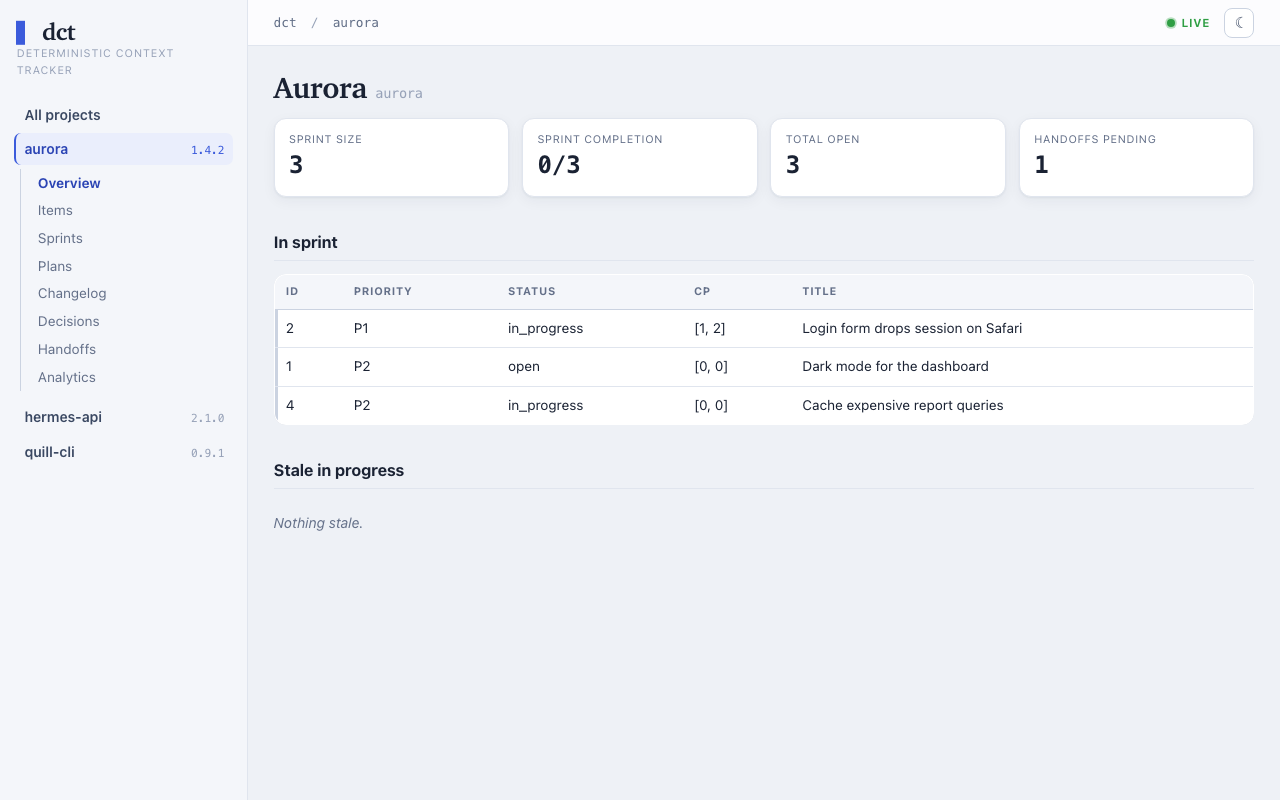
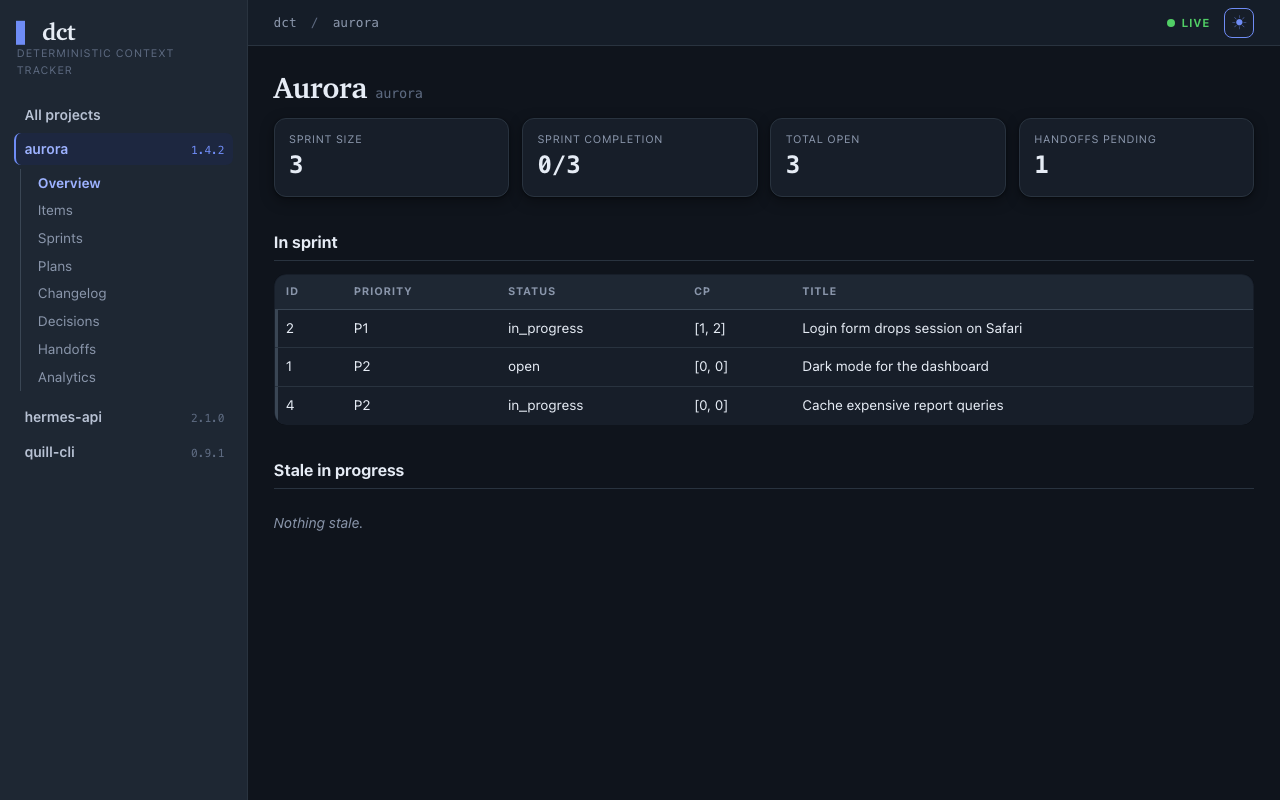
- Local dashboarddct web — a read-only web viewer over the same database.
The blast radius of a change, visible before the damage.
dcg parses your codebase into a graph database and serves it to agents over MCP — 17 tools, Go single binary, Neo4j storage, Python and Go parsers, Django-aware.
> get_impacted billing/models.py::Invoice.total

Invoice.total ─ impacted (14 nodes, depth ≤3)
├─ billing/views.py
│  ├─ InvoiceDetail.get_context_data  [dj:view]
│  └─ export_csv                      [fn]
├─ billing/serializers.py
│  └─ InvoiceSerializer.get_total     [drf:fld]
├─ reports/monthly.py
│  └─ build_revenue_report            [fn] ⚠ entry pt
└─ templates/billing/detail.html      [dj:tpl]

coverage: py 96% · dj 91% · tpl 78%
unparsed: 3 files (listed on request)
Same input, same graph, every time.
Every parser reports coverage — it tells you what it doesn’t know.
One graph query instead of a grep-and-read expedition.
Philosophy
Deterministic
Facts come from a database, not from a model's best guess: same query, same answer. Where a model does help — classifying an ambiguous plan heading — its verdict is written down once and becomes a stored fact, never re-guessed. Determinism here means retrieval: once recorded, state is never inferred again.
Append-only
A ledger, not a whiteboard. Notes, checkpoints and decisions are soft-deleted at most; nothing is ever hard-deleted.
Enforced, not suggested
Gates and hooks live in code, not in convention. An agent commit without a changelog entry doesn't happen — a Claude Code hook blocks it at the tool boundary; a feature with pending gates doesn't resolve.
Local-first
Your tracking data lives in your own database — SQLite in your platform's data directory by default, first-class PostgreSQL when you want a server — and is never uploaded. The only network touchpoints are explicit and optional: a daily PyPI version probe (opt-out) and LLM plan-classification through the claude CLI you already use.
Honest about limits
dcg's parsers report coverage; across the family, the tools tell you what they don't know, so you never mistake a partial answer for a complete one.
Open source
Built in the open.
dct ships under the MIT license and takes issues and pull requests today; dcg opens to contributions with its first public release. Bug reports, docs fixes and framework ideas are all welcome.
Contribute on GitHub →